
Q3 2026 Market Update
After a shaky start, markets were relatively stable over the third quarter of 2026. A slow decline at the start of the quarter was followed by a rapid recovery at the end of July, leaving performance relatively flat overall.
While year-to-date investment performance has been positive, as illustrated by the graph below, returns during the third quarter were more subdued. Equity markets continued to drive performance, with investors at the higher end of the risk scale generally experiencing stronger returns.
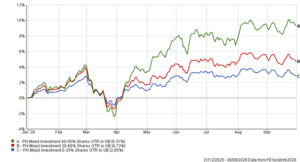
Source: FE fundinfo
Meanwhile, fixed interest investments came under pressure as higher oil prices and geopolitical uncertainty continued to fuel inflation concerns, subduing returns for lower-risk investors.
As we move into the last quarter of the year, politics looks likely to continue influencing financial markets. Whilst the forthcoming UK Autumn Budget will be of interest to UK taxpayers, the US midterms may have broader global market implications. We’ll be monitoring both events closely, and you’ll receive a summary update soon after the UK Autumn Budget on Wednesday 28 October.
In this edition, you’ll find insight on:
- Bond markets struggle against ongoing inflation
- The US midterms could impact global markets
- How geopolitics, inflation and interest rates all interconnect
Bond markets struggle against ongoing inflation
Unlike equity markets, which held up relatively well over the quarter, corporate and government bonds struggled against ongoing inflation fears and disruption to energy supplies as the war between Iran and Israel rumbles on.
Disrupted supplies and high energy prices have reignited fears of global inflation, impacting bond prices and yields.
All of which has led central banks to backpedal on cutting interest rates. Expectations of further rate cuts at the start of the year have largely disappeared, with markets increasingly anticipating interest rate rises as central banks attempt to control inflation.
But this is only part of the story. The other consideration is the impact of higher interest rates on government debt.
According to data from the Commons Library, the government borrowed £77 billion in the first five months of 2026, and total UK government borrowing for 2026 is currently £115.5 billion. On the other side of the Atlantic, US national debt surpassed $40 trillion during Q3 2026.
With expectations of higher interest rates pushing government borrowing costs to levels not seen since 1998, Chancellor John Healey faces difficult decisions as he approaches Labour’s first Budget under Prime Minister Andy Burnham.
For investors, this is a reminder that fixed-interest investments are not immune to market volatility. While bonds continue to play an important role in diversified portfolios, their prices can fluctuate as inflation and interest-rate expectations change.
The US midterms could impact global markets
On the other side of the pond, the US midterm elections take place on 3 November 2026 and could serve as a useful barometer of Trump’s administration.
All 435 seats in the House and 35 seats in the Senate are being contested.
If Democrats gain a majority in the House, they’ll secure greater leverage over US fiscal matters, government funding, and trade oversight. This could give the party more influence, potentially constraining President Trump’s executive power.
We have seen over the last 18 months how President Trump’s policies, rhetoric and military action have influenced global markets.
The outcome of the midterms could therefore help shape the remaining two years of his presidency.
Should the Democrats secure a majority in the House, greater political opposition could also influence the direction of US trade and foreign policy, although President Trump would retain significant executive powers.
Alternatively, should the Republicans retain control of Congress, the administration may have greater scope to continue pursuing its existing policy agenda.
What either outcome would mean for financial markets is far less certain. Greater political constraints might reduce some of the uncertainty associated with US policy decisions, but markets do not necessarily respond positively or negatively to any particular political outcome.
Historically, US stock markets have often performed well following midterm elections. RBC data suggests that the S&P 500 has risen by an average of 14% in the year following midterms, although past performance is no guarantee of future returns.
Ultimately, while the election could influence the direction of US policy over the next two years, predicting how markets will respond remains difficult.
How geopolitics, inflation and interest rates affect all interconnect
One of the clearest lessons from recent months is how events on the other side of the world can have consequences much closer to home.
The ongoing conflict involving Iran has disrupted global energy supplies, contributing to higher oil prices and renewed inflationary pressures. This affects businesses and consumers alike, increasing costs and potentially keeping interest rates higher for longer.
Higher interest rates can put pressure on investment markets, particularly fixed-interest investments, but the impact extends beyond investment portfolios.
Higher borrowing costs also place pressure on governments already carrying substantial debt. In the UK, this creates an additional challenge for Chancellor John Healey as he prepares for the Autumn Budget.
With public finances already under pressure, the Chancellor faces difficult decisions about taxation and spending. Indeed, the BBC reports that he has refused to rule out tax increases, acknowledging that government borrowing costs are at historic highs.
There are, however, some encouraging economic indicators. Recent UK economic growth of 0.4% was stronger than expected, suggesting the economy remains relatively resilient, although inflation stood at 3.1% in August.
Looking ahead, an end to the conflict involving Iran could ease pressure on energy prices and inflation, potentially providing relief to investment markets, government finances and consumers. However, the timing and impact of any resolution remain uncertain.
Recent events demonstrate just how interconnected the global economy has become. Political decisions and geopolitical developments can influence everything from investment returns to household finances and taxation.
We’re here to help you stay focused
As we enter the final quarter of 2026, political and economic uncertainty looks set to remain a feature of the investment landscape.
While markets will continue to respond to events around the world, our focus remains on helping you achieve your long-term financial objectives.
We cannot control or reliably predict these events, but through appropriate diversification, careful consideration of investment risk and a financial plan built around your individual circumstances, we can help you navigate periods of uncertainty with confidence.
If you would like to discuss your investments or the current market environment, please do not hesitate to contact us.
| Please note:
This article is for general information only and does not constitute advice. The information is aimed at retail clients only. All information is correct at the time of writing and is subject to change in the future. The value of your investments (and any income from them) can go down as well as up and you may not get back the full amount you invested. Past performance is not a reliable indicator of future performance. |