
Q2 2026 Market Update
Following the volatility experienced at the end of the first quarter, investment markets rebounded during Q2 despite continued geopolitical tensions in the Middle East and political change in the UK.
In this edition, we share insight into:
- How markets responded as tensions in the Middle East began to ease
- Why political change in the UK had little impact on investors
- What Andy Burnham’s expected leadership could mean for financial planning
Markets looked beyond events in the Middle East
The conflict between the US and Iran remained one of the biggest drivers of market sentiment during the second quarter.
Although further military action followed the announcement of an interim peace agreement, investors responded positively to signs that tensions were beginning to ease. As concerns over disruption to global energy supplies reduced, confidence gradually returned to financial markets.
As the chart below illustrates, diversified investment portfolios delivered positive returns during the second quarter despite an eventful few months.
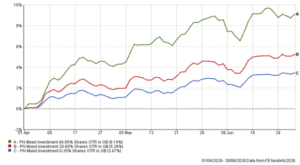
While the situation remains fluid and developments will continue to influence markets from time to time, the second quarter demonstrated that markets are often quick to adjust as expectations change. This reinforces the importance of maintaining a portfolio that reflects your long term objectives, attitude to risk and capacity for loss, rather than reacting to short term events.
For long term investors, it serves as another reminder that periods of uncertainty are a normal part of investing, and that markets can recover more quickly than many expect.
Political change, but little market reaction
Closer to home, Prime Minister Sir Keir Starmer announced his resignation on the 22nd of June, bringing an end to his time in office and triggering a Labour leadership contest.
Despite the significance of the announcement, financial markets remained relatively calm.
This reflects an important distinction. While political developments often dominate the news agenda, markets are generally more interested in the economic policies that may follow than changes in political leadership itself.
Until there is greater clarity on the priorities of the next government, investors are likely to remain focused on the broader economic outlook, including inflation, interest rates and economic growth, rather than political speculation.
As with geopolitical events, the quarter demonstrated that markets are often able to distinguish between uncertainty and fundamental economic change.
Andy Burnham’s expected leadership and what we’ll be watching
With no other candidates currently declaring their intention to stand, Andy Burnham is widely expected to become the next leader of the Labour Party and, in turn, the UK’s next Prime Minister. While the leadership contest has yet to conclude, attention is already turning to what his government may prioritise.
At this stage, there is little indication that a change in leadership will lead to an immediate shift in policy. Without a personal electoral mandate, any new Prime Minister is likely to continue delivering the commitments set out in Labour’s 2024 manifesto while gradually establishing their own priorities.
For us, the focus is less on political personalities and more on policy. Areas such as pensions, Inheritance Tax and ISA reform remain important, particularly where previously announced changes are due to come into effect over the next year. While there has already been speculation about what a change in leadership could mean, it is important to distinguish between political discussion and confirmed government policy.
We will continue to monitor developments closely over the coming months. If any confirmed policy changes are likely to affect your financial plan, we will explain what they mean and discuss any action that may be appropriate.
We’re here to help you stay focused
The second quarter has been another reminder that markets and headlines do not always move in step.
While geopolitical events and political change will continue to shape the news agenda, your financial plan has been built with periods of uncertainty like these in mind.
Your investment portfolio has been designed around your long term goals, attitude to risk and capacity for loss. By remaining focused on your financial plan rather than reacting to short term market movements, you are well placed to navigate changing market conditions and remain on course towards achieving your financial objectives.
If you would like to discuss your investments or the current market environment, please do not hesitate to get in touch.
| Please note:
This article is for general information only and does not constitute advice. The information is aimed at retail clients only. All information is correct at the time of writing and is subject to change in the future. The value of your investments (and any income from them) can go down as well as up and you may not get back the full amount you invested. Past performance is not a reliable indicator of future performance. Investments should be considered over the longer term and should fit in with your overall attitude to risk and financial circumstances. |